Showing posts with label fantasy. Show all posts

Thursday, May 9, 2019

Gi, The World of a Thousand Gods: Solo RPG set-up

In the previous blog post, I had talked about the setting I was writing up for a solo RPG session I want to do. This post will drill down the specifics of the setting as well as the magic and the character I'll be playing. 

The game itself is using Fate Core. For the most part, it's unchanged. The only glaring difference is the magic system I plan on using. I wanted magic to be simple but feel like magic, not just re-flavored skills. However, the concept of using the skill system present in Fate Core as a start was interesting , simple, and couldn't be ignored. I decided to expand on that a bit and add my own little twist to it that will be easy to follow and minimize book-keeping.

Magic in Gi

So right now, the only magic that exists in the setting is divine magic, called Theurgy. Theurgy flows from the presence of the city-gods who form as the cultural, social, and political centers of the cities they protect. The priests that can channel this power are called theurges, and they generally are in the higher ranks of the temple's hierarchy than lay priests. Theurges have a direct connection to their city-god and act as the deity's administrative staff. They handle day-to-day business, running temples and the city, missionary and ambassador work, war-time leadership, and a variety of occupations depending on how much control the temples have over daily life. The goal of each theurge is to become closer and closer to their patron deity, ultimately becoming a part of them at the end of their lives.

Because of their connection, the theurge can channel the divine breath of their god to achieve miracles. These miracles are themed around three characteristics of the city-god; Physical, Mental, and Dominion. These characteristics are simple one-word tags that describe the god, not unlike Aspects. A city-god's physical characteristics could be strong, healthy, lithe, and beautiful. Their mental ones could be clever, wise, brave, and foolish. Dominion is the specific spheres of influence that city-god reigns over. So they could be a goddess of war, or a god of merchants, etc. Generally, I find picking two or three tags for each characteristic is enough to set up a tutelary deity for a theurge.

The ability to use magic costs one skill and one refresh. The theurge buys a skill called Theurgy. This skill grants a set of Fate Dice used to power spells called Olam. You gain an amount of Olam equal to the value of your Theurgy skill. A +3 Theurgy skill will grant you three Olam Dice. Casting a spell requires using an appropriate skill narrated through the lens of your city-gods characteristics, and spending at least one Olam dice. The GM sets the difficulty of the spell before casting, then the theurge adds any number of Olam dice to their skill roll, up to their maximum amount. After rolling, the theurge takes the best four results on their dice and checks to see if they succeed or not.

For example, Daniel is a theurge of Kor, the strong, reckless city-god of competition and sports. He has Theurgy +3, which gives him three Olam dice. Daniel needs to lift a car off of an innocent bystander, but requires the strength of his god for help. The GM decides this will be a Great (+4) Difficulty. Daniel uses Physique +2 to lift the car, and adds 2 Olam dice to it, under the narrative permission that Kor is a strong god. After rolling six dice, Daniel gets 3 pluses, 2 blanks, and 1 minus. Choosing the best of four dice and adding his +2 from Physique, Daniel scores a total of 5 and saves the bystander.

Spells are themed after the citygod's Characteristics and thus should be narratively centered around them, while remaining flexible in their application. The spells are generally instantaneous or at most short-lived effect.

A theurge must be able to breathe in the magic breath of their god and have Olam dice to cast spells. If the theurge runs out of Olam dice or they are choking/suffocating, they cannot cast spells. If a theurge's breathing is restricted, they can choose to spend their lowest available consequence to push through and cast anyways. A theurge can regain Olam dice in one of three ways. First, a full-night's rest followed by a daily devotional to their city-god restores their Olam back to full. Secondly, a theurge can visit a holy place attuned to their god to regain a certain amount of Olam (1 to 3 seems good). Thirdly, in a pinch, a theurge can sacrifice an available consequence to regain Olam dice back. 1 for a Mild, 2 for a Moderate, and 3 for a Severe. 

While the Theurgy Skill isn't rolled for casting spells, it can be used for other actions. Mostly tied to the Overcome action, a mage can use Theurgy to interact with magic objects and places. Ley lines, places of power, relics, sigils, and other foci. Theurgy can also be used to detect magical auras as well as meditate, ask a question and receive a vague omen from their city-god. 

An Example of a City God

Olephi is the city-goddess of Alephdria, a sprawling metropolis in a temperate area of Gi. Olephi is strong and has an intimidating stature. She is wise and stern. She also the goddess of liberty, reason, and defense. So, if we were to write her up in a statblock, it would be:

Olephi
Physical: strong, intimidating
Mental: wise, stern
Dominion: liberty, reason, defense

A theurge of Olephi could cast spells that are centered around these narrative aspects of their goddess. Perhaps they could channel Olephi's wisdom to solve a problem. Or create a shield with her defense characteristic. Or frighten a crowd with her intimidating aura. 

That's it about magic. I wanted it to be limited but flexible and dependent on the difficulty modifiers of each spell. I'm curious what people think about this at their first glance. I'm currently writing up the sessions to post before vacation. I just want to post a blurb about the character I'll be playing first before commiting to the game.

Wednesday, May 8, 2019

The World of a Thousand Gods: A New Setting for Solo RPGs

In the last couple of months, I've been inspired to write up a brand new setting to play in. The idea was inspired by several video games, books, and movies I'd been consuming in that time. This setting is a contemporary fantasy, which is a genre I've had hang-ups with in the past. Generally, I don't like how contemporary fantasy keeps the fantasy hidden away from the mundane world, either as a different world entirely (like Narnia) or under the guise of some conspiracy (like V:tM). I also am not looking to do something like Shadowrun, where magic just suddenly appears. For this, the supernatural and magic elements need to be front and present in my setting, and always has.

A good example would be Eberron, which has elements of the Edwardian era, World War 1 and post-war era, and pulp from that time period while still maintaining the fantastical elements. I simply want to fast-forward the clock even more. Something with the trappings and technology of modern-day Earth, but with the magic and wonder of fantasy existing with it.

Art from Final Fantasy 15
The aesthetics of Final Fantasy 7, 8, and 15 are two examples are what I'm looking for. Sprawling cities protected from the monsters of the outside world. Dragons, mages, and monsters exist alongside smartphones, automobiles, and assault rifles. Of course, in a world where monsters and magic are real, things will have to be set up differently. And thus, the world of Gi was born. One inspired by this artwork as well as ancient Greek City-States, Roman tutelary deities, modern-day Japan's mixture of the spiritual and secular, and the video games Dominions 5, Final Fantasy 7. 8. and 15. Add in a dash of Gnosticism and proto-Judaic religions and shake well!

Art from Final Fantasy 15 (Insomnia)
The world of Gi is one of petty gods and the city-states that they protect and dwell in. The Twilight of the Gods happened many millennia ago, yet the new generation of true gods never came. In their  stead, spirits of the land made a covenant with humans and other races to create large city-states  for protection against the terrible monsters of the world. In return, the peoples of Gi give these tutelary gods offerings and worship, as well as manpower for their wars of divine conquest. The thousands of  years of holy wars, alliances, and politics have led to a modern-day world of sprawling city-states in a cold war with each other. Superpowers have formed into coalitions of pantheons that must fight against enemy city-gods, the wandering monsters from an invading outer realm, and growing allure of materialism.

Art from Final Fantasy 7 Remake
Here lies the heroes. They can be monster hunters that protect the satellite townships and highways from wandering monsters. Or they are the theurges of a city-god, sent as missionaries, ambassadors, or crusaders to neighboring city-states. Or police trying to keep the peace when a riot between humans and orcs breaks out. Anything is possible in Gi, the World of a Thousand Gods

Screen from Final Fantasy 15
This setting will be using Fate, as I want to learn how to use that rule system more and more. I plan on doing more solo RPG sessions in this setting as a way to enjoy it and world build in it. I'd love to run this with a group eventually, but my schedule leaves that uncertain for now. However, the main things I'll post about in the future will be centered around this. Magic (called theurgy), religion, history, monsters, and city-states. I also plan on having some actual plays this coming week on the blog. Gotta get that done before vacation next week. But, it feels good to be excited about world-building again. I can't wait to do more about this setting.


Friday, November 9, 2018

SGAM Ryuutama Session 1: Tholo the Peddler

This is the first session of my Ryuutama game for SGAM. The goal of this first week is to try out a RPG I've never played before. I've heard some talk about the game Ryuutama and some of its themes and mechanics. So, I thought I'd give it a try.


A Brief Bit About The Game

Ryuutama is a Japanese TTRPG that is made for beginners in mind, to teach people about Western TTRPGS like D&D. The game itself is labelled as honobono, which is a more pastoral, heart-warming style of game. It has a charm and style that reminds me heavily of Studio Ghibli films as well as the Dragon Quest video games, both of which I'm very fond of. Instead of a focus on dungeon delving and combat, Ryuutama's adventures revolve around travelling, exploration, and meeting new people.  You gain experience by exploring different sections of the map, with more difficult terrains and weather granting more XP. You also gain XP from combat, but you only get it from the toughest encounter of that session. The standard classes of fighter, mage, thief, and cleric are replaced by professions, like merchant and farmer. In addition, there are three Types that dictate how your character approaches obstacles. They are Attack (the fighter), Technical (the skilled), and Magic (the mage). There are only four attributes (Strength, Dexterity, Intelligence, and Spirit) and the scores are all even numbers from 4 to 12. They are tied to the different dice you have. So if you have a Strength 6, you roll a d6 for your checks. Skills don't exist. You just roll the correct combination of attributes and meet or beat a Target Number to succeed. So for Perception, you roll Dex+Int. If my Dex is a 4 and my Int is a 6, then I would roll a d4+d6. Rolling snake eyes is a fumble, while rolling either boxcars or the maximum of each dice is a critical check.

What is interesting about this game is that it has a GMNPC called the Dragon (or Ryuutama). In the implied setting, these dragons latch onto travelers and feed off of adventures and stories. The Dragon has some GM moves that can either help the players along, or complicate their lives a bit. As the players go through different sessions, this Dragon actually will level up and gain new abilities (called Benedictions and Reveils). After some time, the dragon will grow enough to fly off and leave an egg for the players. The game is an interesting blend of the different styles of Western TTRPGs. There are aspects of classic OSR style gaming with exploration and hexcrawling being big, but also some characteristics of narrative games and story games with the Dragon GMNPC. What I really like about the game is the implied setting, where people simply just decide to travel the world and see new things. It's a rite of passage in a way and while it can seem like a flimsy way to explain why there are adventurers, I think it works with the theme of the game.

I decided that I would give this game a try. Presented below is the first session of Tholo the Peddler, a merchant that has decided to uproot and travel north of his village of Gretelburg. The dragon I chose is the basic Green Dragon (a Midori-Ryuu) named Bard. This dragon is all about exploration and is the suggested one for beginners. For things like random weather, procedural terrain, and encounters, I use The Perilous Wilds' generators as well as Save Vs Dragon's free hex terrain generator found here. For music, since I was inspired by classic JRPGs I played as a child, I used Dragon Quest's Unknown Lands and Never-Ending Journey for travelling, and Final Fantasy VI's battle music.

Session 1: Northward Ho!

Tholo is a young man of lithe build with tawny skin and white hair. Today, he is embarking on his journey, a rite of passage to the people of Gretelburg. Tholo hopes to get a taste of the adventuring life, even if only for a few weeks. With his pack animals fed and equipment set up, Tholo sets out!
It is April 7th, and it is bright and sunny outside. The weather is clear but unseasonably hot for springtime. Tholo wipes the sweat off his brow and travels through the grasslands along the dirt path with his two pack mules and loyal dog, Uno.

Terrain+Weather Difficulty Class (This is the Target Number to beat with the checks down below): 7. Grasslands are fairly safe, but the heat is making it a bit rough.
Condition Check (this is Tholo's current fatigue level): 8. Tholo is feeling pretty good.
Travel Check (this is to see if an injury or exhaustion happens): 8. Tholo doesn't encounter any hardships.
Direction Check (this is to navigate the wilds): Tholo is travelling the roads, so he doesn't get lost.
Encounter: Yes, Friendly.

As Tholo travels north, he spots a wagon on the side of the road with two people by it. They seem to be fixing the wagon wheel and having a rough time of it. Tholo lends a hand, helping the couple fix their wagon to get back on the road. Gratefully for the assistance, the couple introduce themselves as Gregori and Priscilla. Both are newlyweds that have decided to leave their professions and become mail carriers. They go between the frontier towns, bring mail and supplies to them. Greg and Priss also sell things occasionally, dabbling in the mercantile arts here and there. Tholo asks where they are going, and Priscilla says they are going north to Hanselboro from Gretelburg to drop off supplies. Tholo offers to travel with them for a time and the couple agree. The trio set off to the north.

Camping Check (this is to see how they rest for the night and regain HP and MP): 8. The trio have a restful night under the stars, enjoying the cured fish and each other's company.

April 8th. The group is still travelling along the prairies. The weather is pretty hot and muggy, and now there's a rainstorm slowing the party down!
DC: 8. Grasslands are hot and visibility is low due to rain and wind
Condition: 9. Tholo is feeling pretty great
Travel: 8. The trio doesn't encounter any issues travelling
Direction: Despite the rain, they are still along the worn roads so don't need to make this check.
Encounter: No

The rains pelt the canvas-covered wagon, but this doesn't stop our intrepid adventurers. Instead, they talk about their lives before going on their journeys, their goals and dreams, and their homes. Gregori was a bricklayer at a town called Rumplestilton. His claim to fame was helping to rebuild an old bridge that led into the town. Priscilla was a fisher-woman at the same town, responsible for bringing in trouts and bass to the dockside mongers. Both ran into each other during the reopening ceremony of the bridge and decided on a whim to go on their journey together. Greg and Priss fell in love, and when they returned, they had a quaint wedding and decided to live out on the frontier as mail carriers.

Tholo is happy for the couple, and their story inspires him to push forward on his journey even longer. He remarks about how his father was an owner of the village's general store, and that's where Tholo got the itch to become a travelling peddler of wares and goods. But first, he wants to go onto his journey to prove to his family and himself that this is a good idea. He's had Uno for a year and the boxer dog is a great companion.

Camping: 9. The rains clear up some, though there is no starry night tonight. Tholo can't sleep well, as the ground is muddy and uncomfortable.

April 9th. The trio approach a forested area. The rains from the previous day have cooled the area off, but now there is a nasty thunderstorm brewing above Tholo and the gang.
DC: 11. Forests are harder to traverse, and the thunderstorm is slowing the party down greatly.
Condition: 2. Tholo is feeling Out of Shape. He gets the [Poisoned:4] Status Effect, which drops his Strength down to a d4.
Travel: 7. Because of his food poisoning, it complicates travelling. He is at Half HP [8 HP].
Direction: 9. The road is less defined here and the rains are making it hard to travel. The trio only go halfway through the hex.

The heavy rain and winds have made it harder for Tholo and his crew to traverse the forest road. The wagon slows down some as Tholo and Priscilla try to keep the canvas from flying off and Gregori tries to keep the pack animals calm. As they travel, they see a bunch of logs and trees have fallen onto the road, blocking their travel! Tholo is suspicious, but before he can check it out, the shrill cries of something terrible ring out. It's an ambush! Four calico konekogoblins jump from the thickets, clubs in hand, and ready to waylay the trio.

Round 1

Greg is first to react. He draws his short sword and strikes at the first cat goblin. He is able to hit the creature, but barely grazes the cat's shoulder. Priss is next, and she barely misses the second konekogoblin. The koneko strike together, but only the second one lands a hit on the beleaguered Tholo. Luckily for our sick protagonist, his armor helps deflect most of the damage. Tholo has one hand over his sick stomach and the other on a dagger. He strikes at the first konekogoblin that Gregori hit and lands a solid hit, knocking out the first cat monster.

Round 2

Gregori goes again, smacking the second koneko with the flat of his blade. Priscilla tries to hit the second one again, and lands a mighty blow on the feline creature, almost knocking it out! The remaining konekogoblins attack, but all miss. The third one missed so terribly that he drops his weapon on the ground! A boon for our heroes! Tholo takes advantage of this and strikes at the second konekogoblin, felling him in one swoop!

Note: the critical fumble combat effect for the koneko was something I added. I felt it made sense for the scenario, but it's not actually a part of the rules.

Round 3

Here I decided to make a morale roll against the konekogoblins' Condition, since they are now outnumbered. They failed their roll and will now run away. This isn't a part of Ryuutama, just something I generally do for combat in my games.

The remaining two konekogoblins realize that these travellers aren't nearly as easy to ambush as others before them. And so they take off, leaving their fallen cat comrades to the trio. Unsure of what to do to the would-be highwaymen, Tholo and Priscilla tie them up. Using the pack animals and their own two hands, the crew are able to move the logs in about an hour. As they set up camp, Tholo looks at the hungry konekogoblins they captured and feels a bit of pity for them. He takes some of his cured fish rations and give them to the two cat monsters.

Negotiation To Befriend the Konekogoblins: DC 9; I rolled a 13!

The konekogoblins are a bit cautious at first as Tholo approaches, but he presents the cured fish to them and unties the monsters. They sniff the fish as they stare at Tholo to judge his intentions, but soon, hunger takes over and they gobble the food down. 

Camping: 7. It's a rough night for the quintet, and they don't quite regain all of their Health and Mental focus for the night.

April 10th. The party is still in the same hex as before, but now it's a clear and beautiful day!
DC: 8. The weather is clear and temperate, so it's just a matter of travelling through the trees.
Condition: 8. Tholo is able to kick the food poisoning and feels a lot better. [Poison; 4] is now cleared.
Travel: 9. There aren't any hitches in their journey to leave the hex.
Direction: 11. Despite the roads being unclear, the trio make it through to the next hex.
Encounter: Yes; Passive

Tholo and his compatriots travel deeper into the forest, making it to a fork in the road. Hanselboro is more to the west from here, while Tholo wants to keep going north, into the heart of the forest. Gregori and Priscilla warn our hero that in the depths of the overgrown forest, few humans reside. Instead, the spirits of the forest as well as monsters dwell there, waiting to prey on travelers like Tholo. Not one to be dissuaded, Tholo appreciates the concern, but knows that he must continue this journey to prove to himself that he can be a travelling merchant. The konekogoblins, inspired by the kind treatment of Tholo and his willingness to go on, decide to stay with Greg and Priss as helping hands. Priscilla is a little hesitant, but Gregori is more than happy to expand their mail carrier business to their first two employees. Tholo waves goodbye to his newfound friends and heads northeast, ever deeper into the forest.

Along the fading road in the afternoon, Tholo spots something on the ground. Footprints! Giant footprints! Whatever made these prints must be huge! Curiousity overtakes fear, and Tholo runs headfirst into the true wilderness of the lands. What has made these prints, and will Tholo survive the perils of the deep woods? We'll find out in the next session!




Tuesday, May 30, 2017

Solo Gaming Using Mythras Part 1: The Adventure and Setting

So for awhile now, I've been doing practice games with solo gaming to help grok it better. It's been an unusual experience, especially with my inability to sit down for more than an hour to do anything. But, I feel like I've finally got the hang of pulling double duty as PC/GM while also using a good oracle. I've been using Tiny Solitary Soldier's simple oracle, with the caveat that for good/bad chances of a question, I change the probability of Yes or No. So if there is a good chance of something happening, then rolling a 1d6 will yield a Yes on 1-4, while the reverse is true for a bad chance of something happening. Adds a bit more nuance and variety to rolls I feel.

The System

After playing all kinds of game systems out there from FATE and Dungeon World to Savage Worlds and D&D/Pathfinder, I've come to settle down on Mythras. While it is certainly a more complex ruleset than much of the OSR games I've been reading in the last year or so, I've found the rules to be fairly intuitive and easy to understand, as well as fairly deep. And truthfully, I've always leaned to skill-based classless systems the likes of HERO and GURPS. I'd probably still be playing HERO if they hadn't locked me out of the pdfs I bought years ago.

So I will be using Mythras in my campaign setting of Anacaona, one that has seen at least three rules shifts since I started it years ago with Pathfinder, then Savage Worlds, then ACKS, and now Mythras. 

The Setting

I'm not sure I've ever gone over my home setting, but here it is in a nutshell. The setting takes place in a high fantasy world much like the Americas. Folklore and traditions from the different tribes and civilizations of the New World (both Pre and Post Columbian) as well as stories I grew up with as a child are used as inspiration with my own ideas and twists. There are two continents, Thivola to the south and Kivira to the north. In between is a giant chain of islands like Indonesia called Anacaona. This place has a lot of themes from Caribbean natives, as well as inspiration from things like Pirates of the Caribbean, Treasure Island, Age of Sail Caribbean tales, and even some modern day Caribbean folklore and trends.

The islands host a variety of peoples. There are the native civilizations of several island-states that are in a constant cold war among themselves and the new groups of colonists, who themselves fight among each other. The setting begins five years after a terrible series of endemic wars between the natives and colonists that ended with a terrible plague wiping out a great deal of everyone on both sides. Now people have to live in a tense peace, all the while magical zones of arcane energies are popping up.

It is a highly magical place, but not in the sense of something like Warcraft where everyone seems to have world shattering magic. Rather, magic is a part of the world. There are spirits everywhere and demons that roam the islands looking for souls to harvest. Entering a cave can lead you into the underworld, another plane of existence, or even to a completely different time. Besides the magic, you also have to deal with the people. Distrusting natives, paranoid colonists, slave trade, piracy, disease, famine, and the remnants of the great war, and you have a setting rife with conflict.


The Adventure

With all that, I will be running a modified version of Sariniya's Curse, available at the website of The Design Mechanism for free. Only setting stuff is changed, but the main adventure conceit remains.

"Venture-Captain Abraham Spalding is an aging merchant that has spent the last forty years of his life creating a prosperous trade company in the Anacaona Sea. He is a rich man whose name is known throughout the wharves of the islands, and he is able to ply coin from the normally insular native Sulano and Okulek peoples. However, his family houses a dark secret. His father was a Devian soldier and a terrible man, looking to make his fortune in the tropical paradise of Anacaona. Searching for the famed Cities of the Gods, he instead found a smaller village of Sulano with a chest of 65 precious gold coins. Seeing opportunity, the man razed the village, killed the village spirit leader, and took all of the coins and women for himself. In the shaman's dying breath, however, he cursed the man and his kin to die a terrible and gruesome death at the age of 65, one year for each coin stolen. Abraham himself took no heed of this curse, until his father was dismembered by sharks. And then his uncle died painfully from chikungunya. And his mother was found partially eaten alive from a band of ghouls. With his 65th birthday approaching in mere months, Abraham has spent years collecting all 65 coins and has hired the PCs to protect him while he goes to the island of his father's sin to make things right. But what awaits the PCs there may be more than they bargained for..."

That's the basic gist of it. I will be playing with three of the pregenerated characters as well as one that I have made myself. I'll post that for tomorrow. Until then!

Friday, November 18, 2016

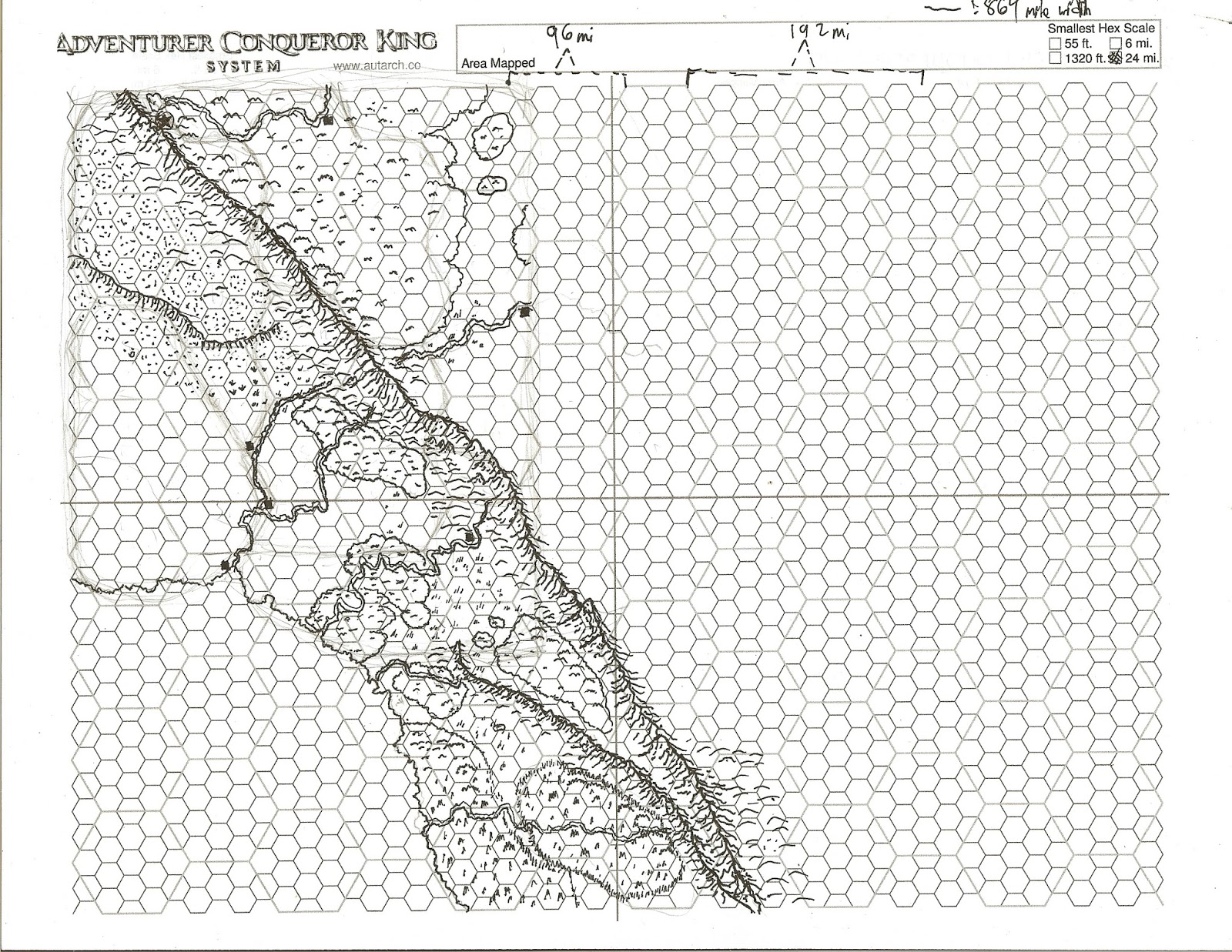
Atlas Map of South Western Thivola (WIP) plus Campaign Stuff

With my 5e/ACKS mashup coming in less than a week, I've been taking a lot of the side work I've been doing the last couple of weeks and getting it all together for Session 1. Setting notes, NPCs, towns, people, monsters... I have quite the treasure trove of stuff ready for this game. While I've played 5e, I have only ever run it once, so I haven't gotten into creating my own races and such yet. Still want to get my sea legs with the current ruleset before I start creating. But I imagine it won't take too long.

Below is the Atlas sized map for South Western Thivola, the continent inspired by South America.


This map in particular is inspired by the Chilean-Argentinean area where Santiago is. The north western part becomes a desert due to the coastline mountain range blocking the trade winds and due to it getting ever so closer to those Horse Latitudes. Further north, there is a plateau similar to the Altiplano. I plan on having a variety of deserts up there. The barren wastelands, the dried up lake turned salt flat, and some sandy dunes. The mountain range is Etapu's Spine, named after the people's founder god of the earth and forests, Etapu. I plan on widening it some more as it goes more south. On the other side of it in the north lie the beginnings of sub tropical wet forest. Further north and east, I'll probably put in some more rain forests and swamps.

As you get more south, the terrain, climate, and vegetation changes to be more green and hilly. The mountains get closer to the coast. The climate becomes more temperate with Mediterranean summers. More rivers and some swamps here and there. This is where the players will be starting their adventures. On the other side of Etapu's Spine, I plan on widening the mountain range to be about 200 mi wide. Very much a montane/alpine area. Then, it will lead to a more arid, steppe-like area of nomadic tribes and such before hitting the coast on the other end.

From here, I have a great variety of terrains and climates that will make exploration and travel interesting to the players. While they will be starting in something a bit more familiar, they can end up in some deserts, rainforests, alpine, or even tundra. All in a geographically close area.

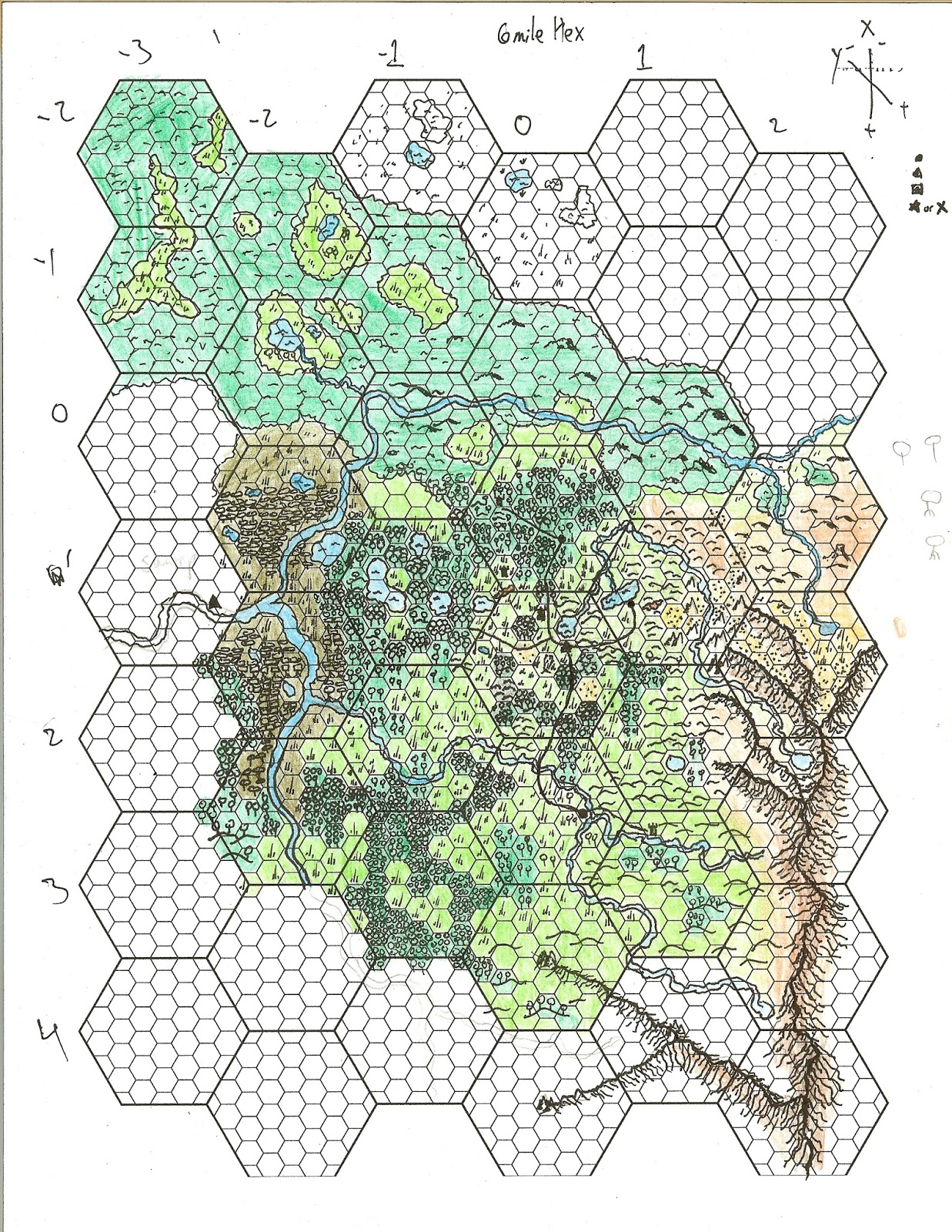
I do have more zoomed in maps for campaign use. I have a Regional Map with small 6-mile hexes that create large 24-mile hexes. I also have a Provincial Map with small 1-mile hexes that create a large 6-mile hex. And finally, I have the Local Map, which just focuses on a single 6 mile hex broken up into 43 1-mile hexes and half/third hexes. Below is a mostly finished Provincial Map. The players will be starting in the large triangle.

I'm bad at coloring within the lines
You can see that from the center to the upper left, my style of drawing changed drastically. I went from doing more symbolic mapping to more iconic mapping. I may redo this at a later point to keep the style consistent and to use a hex map that isn't so dark.

While this campaign is using 5e for the basic rules, I've been using ACKS for a lot of the nation building. You'll notice in the Atlas map that there are some pencil marks that encircle certain areas of the map. These are provinces of the empire ruling over the northern area. The cities are the capital holdings of the nobles in charge of these provinces, built up by ACKS's empire building rules. It was pretty interesting putting the rules to work. Setting up populations and big cities and the empire's metropolis capital in the mountains. The players will be adventuring on the frontier area, away from a lot of these big cities. However, with enough travel time and horses, they can get to one of the capitals in four days. Great if they want to buy and sell expensive stuff, or want more urban adventuring and a break from the wilderness.

I'll get more into detail with the mapping and campaign as the week goes by. Till then, let me know what you think about the maps. 

Tuesday, November 8, 2016

Tension, Stress, Fear, And Fatigue

I've been wanting to do a mechanic for stress and tension in the game to add a bit more atmosphere to my games while having mechanical bonuses/penalties for such things. In making this, I'm looking at something that is easy to run and adjudicate and adds a bit of difficulty and nuance to adventuring. An extra complication to consider before setting off into the great wilds. Much of this is inspired by Darkest Dungeon, a really great game where stress and fear play a big part of adventuring. Some of the rules part and rules decision is inspired by Goblin Punch's sanity rules here as well as the rules in Torchbearer. A lot of this is also inspired by reading my brother's journals about fatigue and mental stress and how the two combine. Here we go!

Fatigue

Fatigue is when your character pushes themselves too hard mentally and physically and their body suffers from it. Forced marches, constant adventuring, dungeon delving, starving themselves, staying up for 24+ hours... these are all physically and mentally taxing on a person. Whenever someone overdoes it and fails their Constitution save, they become Fatigued. Fatigued means you gain a -2 to all d20 rolls made.

A character can still continue to go even when fatigued. Caffeine, adrenaline, and stim packs could be very useful for keeping you up. Every hour you spend doing something while Fatigued, make a Constitution check (DC 10 + 1 for every additional hour active). Failure means you are Exhausted. You take -4 to all d20 rolls and can only move up to half your speed. You also lose your Dexterity to your AC.

If the character still keeps going while Exhausted, then they make the same Constitution checks as before (DC 10 + 1 for every additional hour active). Failure means you are Disabled. You take a -6 to all d20 rolls. You can't make any physical action without making a Constitution check. People that attack you automatically hit. If your GM does coup de grace, then that can happen to you. You're just a human lump at this point, and every hour spent awake or active forces a Constitution check like normal. Failure means you die of exhaustion.

Getting rid of Fatigue generally requires a couple hours of rest. Getting rid of Exhaustion is a whole day affair of rest and relaxation. Getting rid of Disabled is a week minimum of bed rest and some medical attention. 

Tension


Adventuring is a dangerous and stressful career that can be cut short if you don't keep a level head. Any time you encounter something that can make you uneasy, cause some stress, or surprised/shock ed, you gain a point of Tension. This is like a tally mark. Things like seeing a dead body, or the lights going out on you, or hearing the sounds of a crazed monster in the woods at night can all add Tension. Then, the players that gained the Tension Point roll 1d20 + Wis, against a Target Number of 10 + the amount of Tension points. If you meet or beat the TN, your character is fine. If you roll below it. then you get Stressed. Most scenarios should really only give 1 or 2 Tension Points to each player, but some truly gruesome and horrific stuff could give 3 or more.

Stressed

When your character gets Stressed, they have a sort of minor breakdown. They might panic a bit, need to sit down, or vomit. That's up to the character. A Stressed character becomes Fatigued. Being Stressed doesn't go away until you take a couple hours to chill out and relax, generally away from the thing causing stress. Every time your character fails a Tension Roll, they get more Stressed. This becomes Exhaustion, then Disabled, then Death. Eliminating these stress levels can take much longer.

Being Stressed can also be a form of fear, depending on the situation. This works out like normal Stressed, only with some different reactions. Generally, reactions to being stressed out go under the four F's: Fight, Flight, Freeze, or Fawn.

  • Fight: You engage the source of fear in combat, with disregard for the situation.
  • Flight: You panic and flee away as fast as humanly possible, leaving behind anyone
  • Freeze: You are paralyzed with fear and cannot move, hoping that the thing doesn't notice you
  • Fawn: You beg, flatter, or try and reason with the source of fear, praying it will spare you.

A player can choose which action their character takes, or you can roll randomly. I prefer the former, but they have to commit. Sometimes one of the F's works out. Other times it lands you into trouble.

A GM can give a madness to players. This is optional and there are plenty of sites and books with examples, from manias to phobias. I'd suggest picking one that fits the situation, instead of rolling.


Reducing Tension

It's hard to reduce Tension while you are in the scenario causing it, but it is possible. If out adventuring in a dungeon or wilderness, taking a break to shoot the shit with your fellow PCs and NPCs can help drop it by 1 or 2. Finding a safe spot to rest also helps. In a more urban, social adventure, maybe taking an hour or two in the castle courtyard can help you find your center before tackling the corrupted vizier, dropping your Tension down 1 or 2 points. These also make great points for roleplaying with your compatriots, or other friendly NPCs that you know. Leaving the scenario that is causing Tension lets you reduce it all to 0.

Adrenaline Rush

Tension isn't all bad. When the chips are down and you need a boost, you can activate your Tension and get an Adrenaline Rush. For a number of rounds equal to half of your Tension Points (round up, minimum 1 round), you gain advantage on all attack rolls and ability checks. In addition, you ignore all Fatigue effects for these rounds. At the end of your rush, however, you are immediately Stressed out and gain a level of Fatigue. If you were Disabled and did an adrenaline rush, then you die. You pushed your body too far.

Jaded

Adventurers that survive have seen it all and don't get as easily spooked as veterans as they did when they were novices. When players survive a tense scenario or adventure, they can become jaded. That same scenario won't give them any Tension Points. So a player that keeps a level head while getting attacked by zombies won't get Tension Points when encountering future zombies. The only way to affect a jaded individual is escalating the scenario. So a jaded character won't get tense when being attacked by zombies, but maybe seeing them slaughter an entire village trapped in a church might. Fighting ghouls may be fine, but seeing a ghoul drag off your good friend while he's screaming and begging for help will make you Tense. It's all about context, and I encourage GMs not to overly abuse it.

Design Notes

One thing people might notice is that I've created the Fatigue, Exhausted, and Disabled conditions and tied them to stress and fear. Why is that? Well, my brother was once a Marine and I remember reading and hearing him talk about the humps and the fear and tension of being out in Afghanistan. And one thing that stuck from him and other soldiers is how the fear and fatigue really go hand in hand out there. So that's why I united the Fear/Stress mechanic with Fatigue. It simplifies the mechanics and I can use the Fatigue model for other things, like a project I'm working on for clerics.

In addition, I was looking for something a bit less drastic and more down-to-earth with these mechanics. I didn't want random madness tables or sanity scores. Just something a bit more low key.

These rules have been used in one game and were okay, but not enough to test them out. I think they work fine, but I can't wait to put them through their paces more. Tell me what you think about them, and any changes to the ruleset.

Monday, November 7, 2016

Bound in Ruin

"This post is inspired by the Pan-Dungeonism belief discussed over at Hill Cantons. The blog has some great stuff that has really inspired my hexcrawls. Lots of good stuff here to look at, but the Pan-Dungeonism has really struck a cord in my meat noodle, so here we go!"
All things die in the end. People, animals, even the gods themselves will fade away into the afterlife. This has been the way of the world for eons upon countless eons. Though we ourselves have never set foot upon the blessed paradise of Heaven nor the blasted halls of Hell, we know well that our souls make their long trek home with the guidance of grim, sullen-eyed psychopomps.

And yet, who says that creatures and man are the only ones that descend to oblivion?

There is a tablet from an ancient age when men huddled in mud huts for warmth, and the riddle of steel still hung unanswered in the minds of artificers. Written by pressed reeds is a tale of a world of ruins. An entire universe containing the spiritual remnants of civilization. Ancient ziggurats and step pyramids litter the world as testaments to the ephemeral nature of man. Sullen-eyed spirits troll the blackened wasteland, scavenging for information, architecture, or souls hiding in the rubble from damnation.

There is much to pick from the carcass of civilization. Pieces of broken technology can be found and with the right knowledge, refurbished and reused. Lost knowledge can be discovered and traded for the right price. True names, missing people from one's lineage, architecture secrets, lost treasure... the realm of Ruin is the multiverse's landfill. And if someone could find a way to travel there like the ancients were able to, then they can truly make one man's trash into their own treasure.

But how does one make it into the World of Ruin?

There is the current belief that all places of ruin in our world can lead to the World of Ruin.  Places of decay and destruction... like a dungeon. Ruined temples and keeps, old forts from wars long done, steadings razed to the ground, and crypts and tombs can all take us to the World of Ruin with the knowledge of the right ritual to open up a sinkhole in reality. Entering the World of Ruin through these sinkholes is believed to take you to a mirror image of the dungeon you were in, as it sinks further and further into oblivion. From there, it is theorized that you can travel to other sinking dungeons and come back to the real world in its mirror image. You could start your adventure in a ruined temple in a desert and end it at an ancient alien city frozen in the South Pole. All dungeons in the world are connected by the World of Ruin as a sort of network of crumbling dungeons. The implications of travel are incredible to those looking to exploit it. Colonization, military mobilization, trade. All can be improved if these sinkholes were mapped and the ritual was discovered.

Even without the ritual, dungeons can, after a time, have natural sinkholes form. The older the dungeon is, the further it has sunk into the World of Ruin and the greater a chance that one or even more sinkholes into the World have spawned inside. There have been tales of adventures that have traversed between two dungeons in completely separate continents via these portals. But when taken back to the dungeon, the sinkholes have disappeared. Do they only appear for a small amount of time before vanishing? Do these portals change locations for each adventurer that enters the dungeon? Or is this just another case of adventurers telling tall tales?

Wednesday, September 28, 2016

An Exercise in Improvisation, Procedural Generation, and Small Scale Adventuring

For a very long time, I've run games in the same setting. That is, a world that takes influence from aspects of the Early Modern Period, the Age of Sail, and Columbian Exchange in an island chain that is a pastiche of the Caribbean. There you see aspects of swashbuckling tales like The Three Musketeers and Pirates of the Caribbean, weird magic a la Clark and Howard, ancient aliens, gritty sword and sorcery, tales of endemic warfare, and Caribbean folklore, both Taino/Carib and Post Columbian. So you're likely to battle alongside hupia against vicious colonist militia men on the remains of an ancient alien space craft.

However, I've been really interested in trying a campaign where I control very little of the world itself. One that is as randomly created as humanly possible, from the hexmap to the landmarks and adventures that can be found. Doing this was to be an exercise in drawing inspiration from the random and interpreting results to be interesting for adventures, no matter how crazy it may combine. I want to improve my improvisation abilities and remain flexible against weird results, especially since it's a good preparation for dealing with the most random aspect of gaming; your players.

I also had a second goal for this. I've been playing a hell of a lot of Witcher 3 and in that game, you have all this adventure crammed into an area that could be smaller than a six-mile hex. So, I wanted to replicate that feeling of tons of adventure packed in almost 15,000 acres of land. I want each sub hex to have something there that was interesting. Whether it's tracks and spoor of a local creature, a lair of a demon, a city, ruins, landmark... anything that is interesting.

Doing this was interesting, as after a couple hours, I had enough adventures and a campaign that could easily last me weeks, if not months. The books I used were

  • d30 Sandbox Companion: An amazing toolkit that I probably used the most when doing this. I also used the d30 Terrain Hex Generator a great deal.
  • The Perilous Wilds: The second most used book. Even though it's Dungeon World, the Ask the Fates section was great for populating each of my sub hexes.
  • Hex Map Pack: I used this for my hex map. I preferred the 6:1 ratio, but you can use less granular ones if you wish.
  • Dodeca Series: Primarily the Weather generator, because I feel it's the most in-depth climate and weather rules out there. My game is meant to be a wilderness survival game, so weather is important. But everything else in this cheap book is really useful.
  • The Disoriented Ranger's Random Narrative Generator: Along side the adventure generator in the d30SC, +Jens D. blog really helped to add some interesting twists and complications to different things going on.
  • Dice Dungeon Generator: I used my dice dungeon generator whenever a dungeon or ruin rolled itself on my hex map.
  • Vornheim: Despite being a wilderness adventure, I also have a city and ruins to be explored. And this book has always been a staple in my games.
  • Adventure, Conqueror, King: I used this to stock my dungeons and for the economy. The world building aspect is really great too, but I didn't use that this time. Mostly it's because that's better for a top-down approach of campaign building and I was going from a bottom-up approach. If Lairs and Encounters ever come out, I'd love to use that.

My Approach

My only rules were to keep it as random as possible. Things like town names and NPC names and number were created by me.

  1. I started with a single six-mile hex and had several one-mile hexes as the sub hexes. Counting the half and third hexes as separate hexes, this gave me over forty adventuring locations in a single six-mile hex. 
  2. Using the d30 Hex Terrain Generator, I randomly rolled what the middle hex terrain would be, then rolled what each surrounding sub hex's terrain would be until I filled up the six-mile hex.
  3. I used the d30 Natural Features and Phenomena table to fill up the sub hexes with crazy stuff.
  4. I'd then roll a d3 to see how many special and interesting discoveries there were in a given hex. Then, using Perilous Wild's Discovery table, I rolled for each sub hex to see what would be there. I got a lot of threes so this took a bit. Next time I might skip the d3 roll.
  5. For each result of a dungeon, I used my Dice Dungeon Generator to create them. For things like ruins or intact keeps, I used Vornheim's building generator.
  6. I stocked the dungeons and ruins using ACKS, though I tweaked the table to have monsters that would fit a tropical setting. I also used this for treasure stocking.
  7. I rolled for the weather for 14 days. I started the campaign on a New Moon and set up tides at 8A/2P/8P/2A for times. Whenever I roll weather, I always seem to get a tornado result. It's become a joke among my friends.
  8. I then took a look at everything on the hex map and interpreted the results, making connections that seemed like they would work and filling in some results with monsters or NPCs that caught my eye. Also used the d30 NPC Maker to make a lot of NPCs for the area.
  9. For each possible adventure, I used the Random Narrative Generator. For simple quests, I only rolled on it once or twice. For more in depth adventures, I rolled three to four times, and for longer campaigns, I rolled five times.
  10. Made a random encounter table
  11. Had a beer
The original terrain map after rolling
Above is the preliminary hex map. Big hex is 6 miles and the sub hexes are 1 mile. The letters are the terrain for the area. W is water, H is hill, F is forest, S is swamp, and P is plain. WZ stands for Wild Zone, which is a campaign specific hex that I talk about here and here

At this point, I had made all the connections and was essentially ready to run the campaign. I wrote down all of the adventure ideas that I had randomly rolled up and interpreted and I have to say, I was really excited for what was created. The biggest thing I like is that each 1 mile hex has at least three interesting hooks in there for adventures. Everything from treasure maps to tracks of a creature to dungeons to NPCs. And the best part is that despite the results looking quite disparate, the adventure narrative between things really work out. On paper, this looks fun and I can't wait to run this for a group. Once I get my scanner working, I'll have to post my notes up on everything.

I learned that there is a greater value to random rolls than I honestly first imagined, even with my love of random tables. I feel a bit more in the right headspace for the world because I've had to interpret everything instead of creating, though there was plenty of creating from the inspiration of the rolls. I think that my improvisation skills will benefit from this little exercise. Now I just need  a chance to run it.

My next post, I want to post up the final map and the notes I made for each area that I rolled up. With the move and packing, my time will be a bit limited on what I can post.